Reading note. The figures cited here come from analyses published by SemiAnalysis and relayed by Business Insider in June 2026. They are lab measurements, under favorable conditions, produced by a party close to the NVIDIA ecosystem. We treat them as a solid trend, not a universal truth. Hedging is assumed throughout.
In one sentence
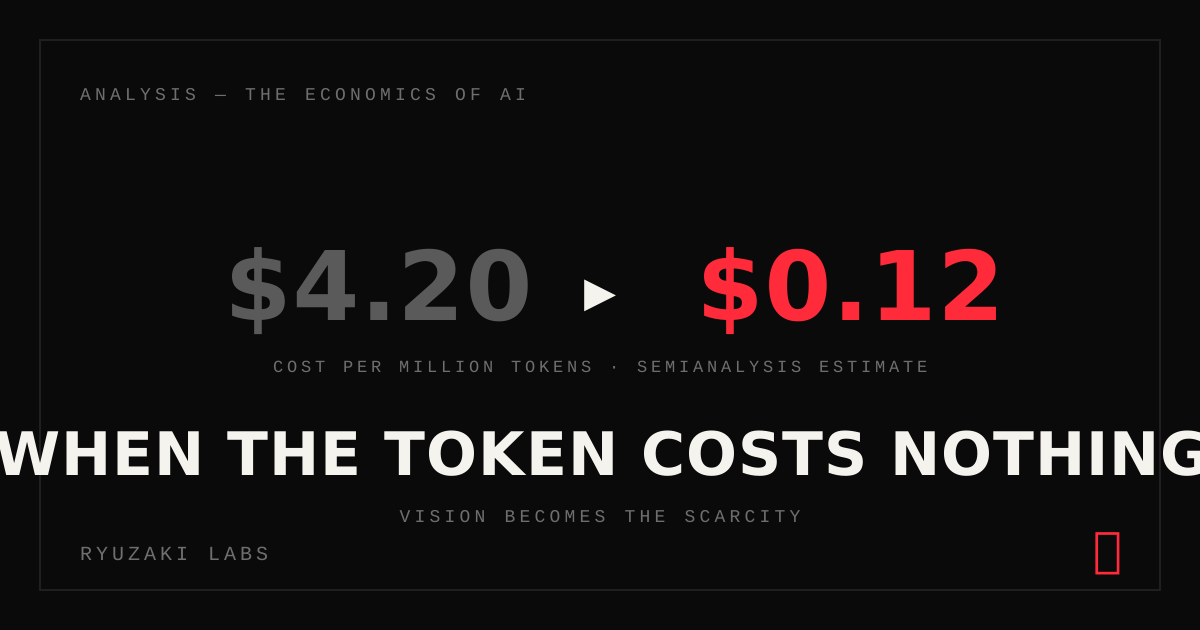
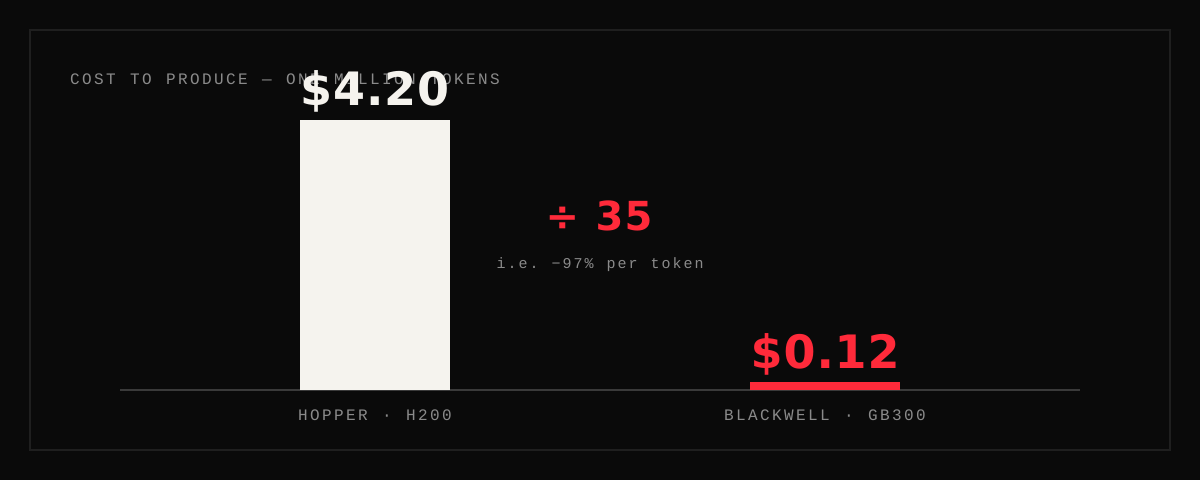
The cost to produce a million tokens would fall, according to SemiAnalysis, from around $4.20 on the previous chip generation to about $0.12 on NVIDIA's new Blackwell cards — roughly 35 times cheaper. If the trend holds, access to AI stops being an advantage: it becomes a commodity. And when the raw material becomes nearly free, value shifts to what remains scarce — domain data, usage, and vision.
1. What the Numbers Say
From the second half of 2026, NVIDIA is rolling out at scale its Blackwell chip generation (GB300 NVL72 systems). SemiAnalysis compared their efficiency with the previous generation, Hopper (H200). The reported gaps are of an unusual order of magnitude.
Three figures stand out from the reporting:
- Cost per million tokens: on the order of $4.20 down to $0.12, a reduction of roughly 97%.
- Tokens per megawatt: at equal electrical power, Blackwell would produce up to 50 times more tokens than Hopper.
- Deployment: the ramp-up is expected in the second half of 2026, which — if the trend holds — would steadily increase the supply of low-cost tokens.
The context confirms it elsewhere. Sam Altman has publicly acknowledged that "AI costs have become a significant issue." When the providers themselves talk about cost as a problem, the pressure is real.
2. Two Reading Traps
Before drawing conclusions, two nuances that media coverage often glosses over.
Production cost ≠ market price. That producing a token costs 35 times less does not mean the billed price will drop by as much. Part of the economics is captured by margins, the amortization of chips (which are expensive to buy), and energy. The decline will come — it has already begun on some segments — but probably unevenly.
The Jevons paradox. When a resource becomes cheaper, we don't consume less of it: we consume far more. Cheap tokens mean models called ten times over, agents reasoning in loops, long tasks we'd never have launched at full price. A company's total bill may well rise even as the unit price collapses. The collapse of the unit cost is not the end of spending — it is the beginning of a different kind of usage.
"A resource that becomes abundant stops being a competitive advantage. But it doesn't stop having value — the value is in what you do with it."
3. Value Moves — Where?
This is the heart of it. For two years, the dominant narrative was: "whoever has the best models wins." That narrative is aging. If the token becomes a commodity, having access to AI no longer sets anyone apart — just as having access to electricity no longer sets a factory apart.
Value then migrates to what remains scarce and hard to copy:
- Domain data — a generic model belongs to everyone; your data, your use cases, your field history do not.
- The simple interface — the ability to make raw power usable by a human who has neither the time nor the desire to learn how to prompt.
- Field integration — wiring AI into the real tools, real processes, and real constraints of an organization.
- Speed of execution — turning an idea into a product before others do, when everyone has access to the same raw material.
- Understanding the problem — knowing which problem is worth solving, which no model does for you.
We already wrote this about code, in Software Engineering Isn't Dead: when production becomes abundant, it is not the end of the craft, it is the end of the monopoly on value. The token follows exactly the same curve as code. And the conclusion is the same: the winners will not be those who consume the most AI, but those who best understand the problem to solve.
4. What It Changes, Actor by Actor
- The sellers of "magic" — those who bill access to AI as a rare feat will get caught out. When the cost base collapses, the "it's expensive because it's AI" line no longer holds.
- Infrastructure vendors — the battle shifts to efficiency per watt and per dollar. This is exactly the logic of the Law of Tau: the advantage is no longer raw power, but efficiency.
- Small outfits, associations, independents — potential big winners. A collapsing raw material democratizes production. What was reserved for the giants becomes accessible to a team of three — provided you have the data and the vision.
- Organizations with no direction — the big losers. AI ten times cheaper applied to a bad idea is still a bad idea, just served faster and at greater volume.
5. Signals to Watch
- The production / billed-price gap. Will consumer APIs pass the drop through, and how fast? The gap between cost base and price will reveal who captures the value.
- Total consumption. If the Jevons paradox plays out, token volumes will explode faster than prices fall. Worth watching in the major labs' announcements.
- The new viable use cases. Long, agentic tasks that were too expensive will become economically ordinary. That's where the interesting products will be born.
- The independence of the figures. Will measurements from parties unrelated to NVIDIA confirm the order of magnitude? As long as the main source stays close to the vendor, caution is in order.
6. A Situated Word
From Réunion Island, 9,000 km from the compute centers that produce these tokens, this news has a particular taste. For years, frontier AI seemed reserved for those who could pay its price. If the raw material becomes nearly free, the financial barrier falls away — and only the barrier we actually care about remains: knowing what to do with it.
That is good news for a frugal lab. We have never bet on how much AI is consumed, but on how relevant the usage is. An island territory, a small association, a craftsperson: none of them needs the biggest model in the world. They need the right problem, well framed, solved with the simplest tool that works.
AI is becoming a commodity. That is precisely why the real scarcity, tomorrow, will not be power. It will be vision.
Sources and Further Reading
- Business Insider — "AI token prices may crash as Nvidia Blackwell GPUs scale" (June 2026) — The article behind this note; relays the SemiAnalysis analysis and Sam Altman's remarks.
- SemiAnalysis — Comparative analysis of GB300 NVL72 (Blackwell) against H200 (Hopper); source of the cost and efficiency figures (a party close to the NVIDIA ecosystem — read it as such).
- NVIDIA — InferenceX / InferenceMAX data on Blackwell Ultra — Up to 50x throughput per megawatt and 35x lower cost per token claimed (vendor figures).
- Ryuzaki Labs — Software Engineering Isn't Dead and The Law of Tau — Two analyses on commoditization and efficiency, whose reasoning this piece extends.
This document is updated if new elements emerge. Last revision: 文 June 13, 2026.