Reading note. This article draws on events that unfolded between June 9 and June 12, 2026, and were still settling as we wrote. We cite the available public sources and flag what is estimate or unconfirmed reporting. The situation may evolve; the last revision date is at the bottom of the page.
In one sentence
On June 9, 2026, Anthropic made Fable 5 public — its most powerful model available to the general public. On June 12, the U.S. government ordered it cut off from every foreign national, anywhere in the world. In seventy-two hours, a capability offered to the planet became a lever of national security. This is, in our view, the clearest demonstration to date that the real subject of AI is not performance — it is sovereignty.
1. Seventy-Two Hours
Let us replay the timeline, because it says everything.
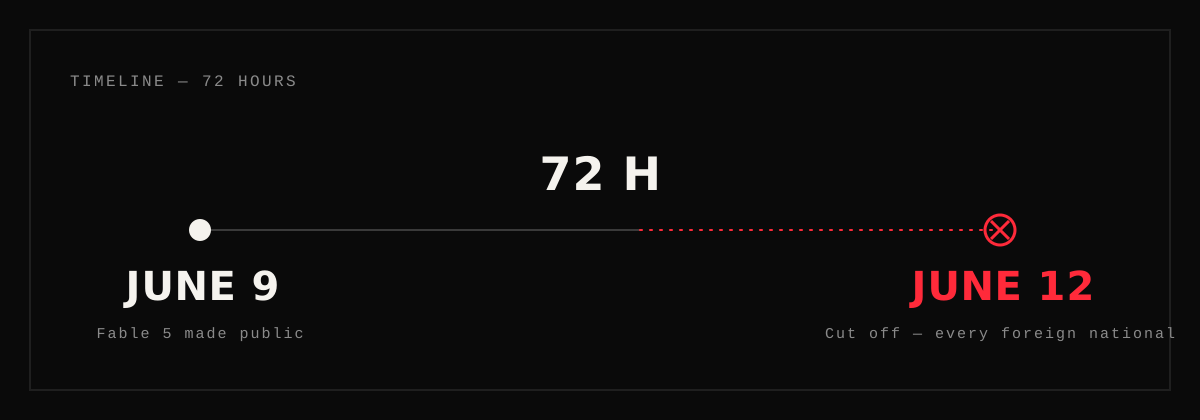
June 9. Anthropic releases Claude Fable 5, the first publicly available model in the "Mythos" family — the same lineage that rattled the cybersecurity world earlier this year for its ability to find and exploit vulnerabilities. Fable 5 is announced at the top of the rankings on software engineering, knowledge work, vision, and scientific research, with the ability to sustain long, complex, asynchronous tasks that earlier generations could not. Announced pricing: on the order of $10 per million tokens of input, $50 per million of output.
June 12, Friday afternoon. Commerce Secretary Howard Lutnick sends a letter to Dario Amodei, Anthropic's CEO. Fable 5 and Mythos 5 are placed under export controls. The order, as reported by Axios, CNBC, and NBC News, is unambiguous: suspend all access to the models "by any foreign national, whether inside or outside the United States, including foreign national Anthropic employees."
The stated reason, per those same sources: another company demonstrated a way to bypass — to jailbreak — the model's safeguards, alarming the administration about possible national security risks. Anthropic, for its part, pushes back: in its official statement, the company writes that it "disagrees that the finding of a narrow potential jailbreak should be cause for recalling a commercial model deployed to hundreds of millions of people." But it complies, and cuts access for all of its customers to ensure compliance.
A model open to the world on Monday. Closed to every foreigner by Friday. No trial, no notice, on the basis of a demonstration the vendor itself considers minor.
2. A "Frontier Model," and Why a State Gets Involved
A short detour, necessary for what follows.
Frontier model — the most advanced AI systems of the moment, the ones pushing the limit of what a machine can do. They are expensive to train (on the order of hundreds of millions of dollars), few in number, and concentrated among a handful of labs, almost all American or Chinese.
Dual use — the same capability that writes high-quality code can also find its flaws. A model that excels at software engineering is, by construction, excellent at finding vulnerabilities. That is precisely what makes Fable 5 useful and sensitive.
Export controls — the legal arsenal by which a state restricts the spread of a technology deemed strategic beyond its borders. Designed for semiconductors and military hardware, it now applies to a language model. This is new, and it is no detail: it establishes that, in Washington's eyes, a frontier LLM is a defense asset.
That is the heart of the shift. As long as a model is a product, it answers to the market. The moment it becomes a national security asset, it answers to a state. Fable 5 changed category in three days.
3. Sovereignty Is Not Performance
This is where we want to reframe the dominant debate.
For two years, the AI race has been told in benchmarks: who has the best model, the most parameters, the highest score. Performance has become the only visible metric. Yet the Fable 5 episode shows that performance, on its own, protects nothing.
"The best model in the world is worth nothing if someone else holds the switch."
For a country, an administration, a company building its information systems on an AI capability, three questions matter more than the ranking:
- Who can cut off access? In Fable 5's case, a single foreign ministry, by letter, on a Friday afternoon.
- On what terms? Not a commercial contract, not advance notice: a sovereign decision driven by another country's national security.
- What becomes of the system that depended on it? It stops, or falls back to a degraded mode. Anthropic, in fact, planned for this: on its high-risk topics, the model already falls back to an earlier generation (Opus 4.8).
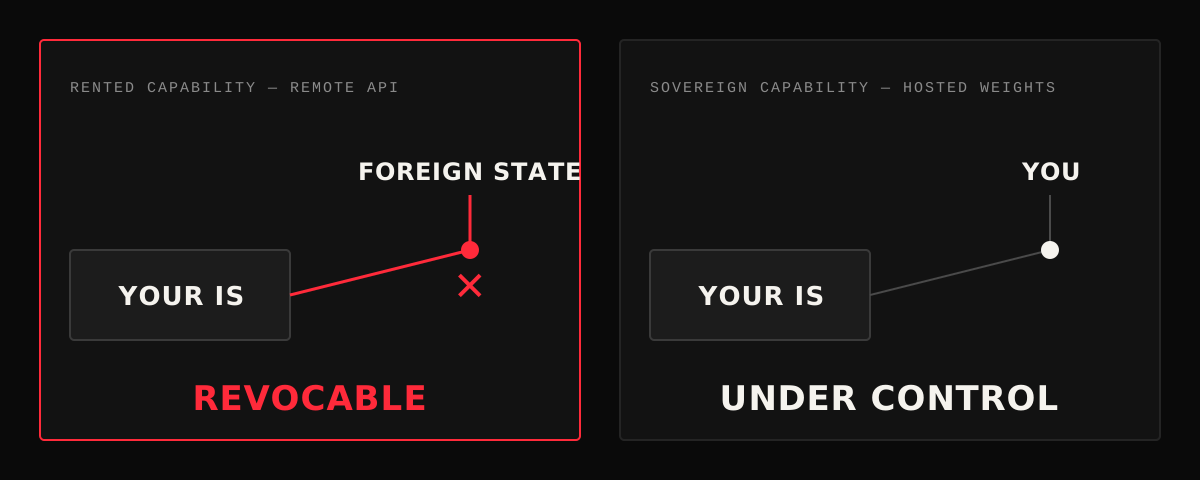
The lesson, then, is not "you need the best model." It is "you need a model whose availability does not depend on the goodwill of a foreign state." Capability you consume without controlling it is not an asset: it is a dependency, and a dependency can be revoked.
What is striking here is that the shutdown did not even come from an adversary. It came from the lab's host country. If the United States can pull Fable 5 from its own allies, the argument "our suppliers are our friends" no longer holds. Sovereignty is not measured by the quality of today's diplomatic relationship; it is measured by what happens the day that relationship sours.
4. What It Changes for France and Europe
The intuition — shared by many — was that France will "sooner or later need frontier models" to capture the technological gain a Fable offers in producing and steering information systems. We share it — but the June 12 episode shifts its justification.
The point is not merely to catch up on capability. It is to avoid building a country's digital state, hospitals, banks, and administrations on a brick that Washington — or tomorrow Beijing — can withdraw unilaterally. When SNCF, Veolia, or Stellantis adopt an AI for their internal deployments, the question is no longer only "is it powerful?" but "who decides whether it stays in service?"
This is precisely Mistral's bet — in under three years it has become the standard-bearer of a European "sovereign AI." Valued, according to figures reported in the press, at around €11.7 billion after its September 2025 Series C, the Paris-based lab reportedly raised on the order of $830 million in debt in late March 2026 to deploy roughly 13,800 GPUs in a data center south of Paris — the infrastructure said to be needed to train, by the end of 2026, a frontier model able to rival the best American systems. If the trajectory holds, Europe would have, for the first time, a frontier model and the switch that goes with it.
What the Fable 5 affair adds to the file is urgency and a criterion. The sovereignty criterion is not "was it built in France?" in a marketing sense. It is, concretely:
- Training — is the model trained on infrastructure you control?
- Weights — are the model's parameters owned, hostable, and not merely rented through a remote API?
- The hardware chain — the chips, still largely imported, remain the weak link; software sovereignty without hardware sovereignty stays partial.
On the first two points, Europe can move fast. On the third, the horizon is longer.
5. Signals to Watch
For the reader who wants to check where this story goes in the weeks ahead:
- Fable 5's fate. Anthropic says it is working to restore access and considers the decision based on "a misunderstanding." Will it be restored for foreigners, on what terms, and with what new safeguards? The answer will tell us whether June 2026 was an incident or a precedent.
- The expansion of export controls. If the logic applied to Fable extends to other frontier models, worldwide access to the best AI will become structurally conditioned on the user's nationality. That would be a regime change.
- Mistral's frontier model. An actual release by the end of 2026, at comparable performance, would validate the option of European autonomy. A delay would weaken it.
- The reaction of public buyers. Will state and local-government tenders include a "sovereign reversibility" clause — a guarantee against depending on a capability a foreign power can switch off?
6. A Situated Word
We write from Réunion Island, 9,000 km from Silicon Valley and a little further still from Washington. From here, technological dependence is not a seminar abstraction: it is a daily experience. The network, the hardware, the services — much of it arrives from elsewhere, and you quickly learn what a shutdown decided far from home can cost.
The Fable 5 affair replays, at the scale of AI, what peripheries have known for a long time: value you do not host, you do not control. For an island territory, a small outfit, an association, the conclusion is not to give up the best tools — that would be absurd — but to keep, alongside them, a frugal capability no one can switch off. A more modest model running on a machine you own is sometimes worth more than a brilliant model you rent from a supplier a state can order to shut off the tap.
That, ultimately, is the whole point of what we explore here: not the race for the greatest power, but the search for a tenable autonomy. Fable 5 reminds us that the first is spectacular, and the second, strategic.
Technological sovereignty is not the backdrop to the AI story. It is its heart.
Sources and Further Reading
- Axios — "Trump admin blocks foreign access to Anthropic's most powerful AI" — Broke the Commerce Department directive and its scope (every foreign national).
- CNBC — Fable 5 launch and access disabled to comply with the directive.
- NBC News — "Anthropic suspends new AI models after government directive" — Cybersecurity context and the Mythos lineage.
- Anthropic — Official statement on the suspension — The vendor's position, disagreement, and commitment to restore access.
- Tech-insider — Mistral AI, Europe's sovereign bet (2026) — Valuation and infrastructure figures (reported, not officially confirmed by the vendor).
This document is updated if new elements emerge. Last revision: 文 June 13, 2026.