Reading note. This article draws on announcements made during Nvidia's Computex 2026 keynote (May 31 – June 1, 2026, Taipei) and on coverage by the specialized technical press (Tom's Hardware, The Register, Engadget, TechRadar). The quoted figures (core counts, performance, memory) are as reported and have not yet been verified on silicon by independent third parties. Pricing and availability remain indicative as of writing.
In one sentence
At Computex 2026, Nvidia introduced RTX Spark, a single chip that brings together an Arm processor and a Blackwell GPU around shared memory, aimed at Windows PCs. Five years after Apple moved the Mac to its own Arm chips, the PC world faces the same break — and this time it is the Nvidia + Microsoft pairing that holds both ends of the stack, from silicon to operating system.
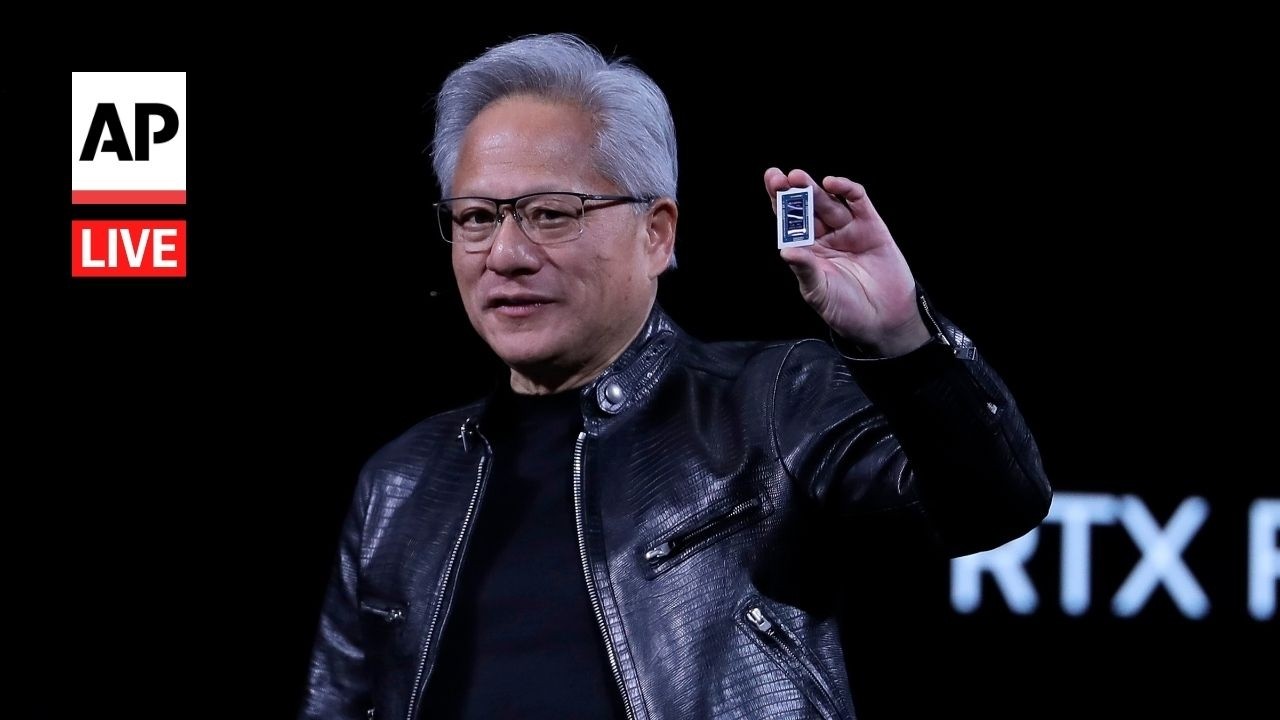
Jensen Huang's full Computex 2026 keynote (~2 h): youtube.com/watch?v=gxgi6D-Cf9I
1. What was announced, and why it matters
On June 1, 2026, on the Taipei stage, Jensen Huang did something Nvidia had never done: introduce a chip aimed at the mainstream Windows PC, rather than only the data center or the add-in graphics card.
According to press reports, RTX Spark combines:
- an integrated Blackwell GPU — on the order of 6,144 RTX cores, per Engadget;
- an Arm processor with around twenty cores, co-designed with MediaTek;
- 128GB of unified memory, shared between CPU and GPU;
- announced performance of about one petaflop on low-precision AI workloads.
More than thirty laptops and around ten desktops built on the platform are expected "this fall" from Dell, HP, Asus, Lenovo and MSI. At the same time, Nvidia now describes itself not as a GPU maker but as an "infrastructure company" — Huang's own phrasing on stage.
The detail that makes the difference lies elsewhere than in the numbers: the Arm side was reportedly developed with Microsoft. In other words, the silicon and the operating system advance together. That is exactly the setup that let Apple pull off its transition.
2. What is an "Apple Silicon moment"?
To understand the analogy, go back to 2020. That year, Apple dropped the Intel x86 processors that had powered the Mac for fifteen years and switched to its own chip, the M1, built on the Arm architecture. Three technical choices, inseparable from one another, explain the success that followed:
Arm architecture — An instruction set originally designed for mobile devices, and therefore built for performance per watt rather than raw power at any cost. Where the PC world piled on power draw, Apple optimized for energy efficiency.
Unified memory — Instead of one pool of RAM for the processor and another for the graphics card, a single shared memory, physically close to both. Data no longer has to be copied from one to the other: you gain latency, bandwidth and simplicity.
Vertical integration — Because Apple controlled both the chip and macOS, hardware and software were optimized for each other. It is that coupling, more than any single part, that produced the gap in performance and battery life.
The "Apple Silicon moment" is therefore less a chip than a method: bringing general-purpose compute, graphics compute and memory into one coherent whole, controlled end to end. That is precisely what RTX Spark is attempting to replicate — but for the open PC ecosystem, where the silicon (Nvidia) and the OS (Microsoft) belong to two separate houses that choose to move together.
3. Two simultaneous breaks
The Computex announcement reads on two levels at once: a break in hardware, and a break in usage. It is their combination that makes the moment interesting.
3a. The hardware break: the end of x86's reign over the PC
For forty years, the PC has rested on the x86 architecture of Intel and AMD, and on a clean separation between processor, RAM and graphics card. RTX Spark challenges both pillars at once.
First by moving to Arm, like Apple, but on terrain where Qualcomm had already tried — without lasting success — with its Snapdragon chips for Windows. Qualcomm's departure from the Windows-on-Arm exclusivity, as reported by Tom's Hardware, is precisely what clears the path for Nvidia.
Then by adopting unified memory at scale: 128GB shared is a capacity that, on a conventional PC, would require a data-center graphics card. This point is decisive for AI, because the size of a model you can run locally depends first and foremost on the memory available to the GPU.
3b. The usage break: inference returns to the desktop
The second break is quieter but deeper. Since generative AI exploded in 2022, inference — actually running an already-trained model to produce an answer — almost always happens in the cloud, on remote servers billed by usage.
With 128GB of unified memory sitting on a desk, part of that computation can come back down to the local machine. A mid-sized model, until now confined to servers, becomes runnable at home, offline, without sending your data to a third party, without a meter ticking.
It is the same pendulum swing computing has known since its beginnings: centralization, then decentralization, then re-centralization. RTX Spark pushes the needle toward the edge of the network — toward compute placed as close to the user as possible.
3c. Microsoft's role: turning Windows into an AI system
Hardware is not enough. Apple's lesson is that a chip is only worth as much as the system that knows how to use it. That is where Microsoft comes in.
According to the announcements, RTX Spark aims to make Windows an "agentic operating system" — a system where AI agents run continuously in the background, locally, assisting the user without depending on the cloud. The continuity with the Copilot+ strategy of the past two years is clear.
If this integration holds, Microsoft holds the equivalent of macOS in the analogy: the software layer tailored to the silicon. Nvidia provides the engine; Microsoft, the dashboard. Together, the pair reconstitutes what Apple holds alone.
French-language breakdown of the RTX Spark announcement: youtube.com/watch?v=_tHhYJC6HLY
4. What it changes for everyone else
If the platform delivers on its promises — and that is still an if — the marker it plants forces everyone to reposition.
- Intel and AMD — The x86 duopoly is attacked head-on on the most visible segment: the Windows PC. Their answer will be fought on software compatibility and energy efficiency, terrain where Arm holds a structural advantage.
- Qualcomm — The Windows-on-Arm pioneer now sees a competitor arrive with a dominant GPU brand and the ear of AI developers. Its head-start window is closing.
- Apple — The M-series loses its exceptional status. The argument that "Arm unified memory is only here" falls away. Competition shifts to the software ecosystem, where Apple remains strong.
- Cloud providers — If local inference becomes credible for part of the workload, a fraction of AI demand could stop flowing through their servers. A marginal effect in the short term, an underlying signal to watch.
- Developers — Having 128GB of GPU memory locally changes the economics of prototyping: you can iterate on large models without a cloud bill, network latency, or sensitive-data leakage.
5. Signals to watch over the coming months
- The first independent benchmarks — The announced figures (petaflop, cores, memory) must be tested against real silicon by third-party labs. Until that happens, caution.
- The retail price — A platform with 128GB of unified memory could target the well-funded developer or the mainstream buyer. The pricing will reveal the real ambition.
- Software compatibility — The Achilles' heel of any move to Arm under Windows. The share of x86 applications running correctly, and how fast, will be decisive.
- The roadmap — Nvidia sketched several generations (Rubin with LPDDR6 memory, then the next step). The announced cadence will tell whether this is a one-off or a trajectory.
- Microsoft's real commitment — How deeply Windows is optimized for this chip, beyond the announcement gloss, will make or break the "Apple Silicon moment."
6. A situated word
We write from Réunion Island, 9,000 km from Taipei and from Silicon Valley alike. Seen from here, the Computex announcement is not first about RTX cores or petaflops.
What interests us is the possible relocation of compute. For an island territory, dependent on submarine cables to reach the major data centers, the idea that a useful model could run on-site, offline, with no meter running is not a comfort detail: it is a matter of technical sovereignty and frugality.
A desktop machine able to run a respectably sized model locally is a frugal lab that stops being at the mercy of latency and of a distant provider's inference prices. If RTX Spark's promise holds, the winner is not only Nvidia or Microsoft — it is also, perhaps, the one who works far from the center and earns the right to compute at home.
To each their part. Ours is played at the edge of the network.
Sources and further reading
- Nvidia — Computex 2026 keynote (Jensen Huang) — Full video, YouTube. Primary source for the announcements.
- Tom's Hardware — Coverage of the RTX Spark announcement, the roadmap (Rubin / LPDDR6) and the Qualcomm / Windows-on-Arm context.
- Engadget — "NVIDIA's RTX Spark is an AI superchip that will power Windows laptops and desktops" — detail of the reported specifications.
- The Register — "Nvidia's Grace Blackwell superchips are officially coming to the PC" — technical analysis of bringing GB10 to the PC.
- TechRadar — Keynote live blog: "RTX Spark announced to take on Apple, Intel, and Qualcomm."
- Apple (2020) — The M1 launch, the historical reference for the Arm + unified memory + vertical integration shift.
This document is updated if new elements emerge. Last revision: 文 June 2, 2026.